Our Mission
Saving democracy from oligarchy is crucial for shaping its future. Current responses are inadequate, lacking a systemic understanding of oligarchic power and often being too abstract. Our research project, funded by the Gerda Henkel Foundation, aims to address oligarchic tendencies through a unified approach that identifies power structures and remedies at both institutional and civil society levels.
Updates
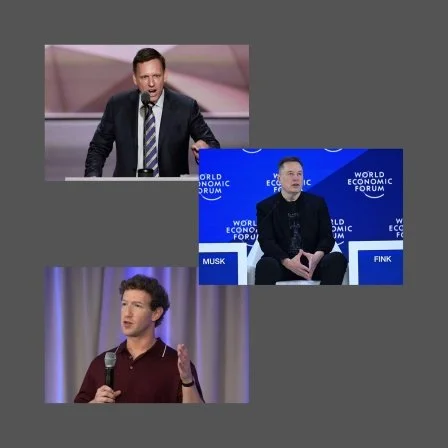
They see themselves as defenders of freedom: tech bosses like Elon Musk, Mark Zuckerberg, and Peter Thiel. But at the same time, it has becoming increasingly clear that moderate voices carry far less weight on social media platforms than the haters because traffic generated through polarization creates profit. Simultaneously, it is becoming apparent that the wealthy are better able to advance their agendas in legislative processes. This is because they have access to powerful figures, employ lobbyists, and exert influence through party donations. Is our democracy under threat? Media scholar Martin Andree, democracy researcher Janosch Prinz, and BR network specialist Christian Schiffer discuss this question.
Are the rich of the world taking power for themselves? We already knew from Russia that billionaires were in charge. Now America is also warning of an ‘oligarchy’. But what is that actually? And what dangers are hidden behind that term? In Maastricht they are investigating it. “We say: be alert.”
“De oligarchen waren altijd al aan de macht, ook in Nederland”
The oligarchs have always been in power, also in the Netherlands Democracy in the US seems to be taking a back seat now that Elon Musk is calling the shots in the federal government. But oligarchs like him have always had a lot of influence, says political philosopher Janosch Prinz. And the Netherlands also has an 'oligarchic democracy'.
The problem of oligarchy is a problem of undue influence of wealth on politics. This problem takes a specific form in liberal-democratic, capitalist regimes. The daily spectacle of the Trump-Musk billionaire duo is just a particularly stark example—as was perhaps to be expected in a country traditionally relaxed about the role of money in politics. But that hasty comparative judgment obscures the more fundamental problem: can we decouple wealth from political power at all?
Oxfam's latest annual inequality report, Takers Not Makers, released last month, is shocking reading. It explored how most billionaire wealth is taken, not earned, with 60% coming from either inheritance, cronyism or monopoly of power. Globally, the 10 richest people are all men and their wealth increased by more than $150 million a day on average.
Last year, Australian billionaires' wealth increased by more than 8 per cent, or $28 billion.
Nightlife is joined by the head of Oxfam in Australia, Lyn Morgain, and the head of a research team based in the Netherlands working on a project titled Contours of Non-Oligarchic Futures, Janosch Prinz, Assistant Professor in Social and Political Philosophy. Join Philip Clark as they discuss what can be done to change things, to redress the basic inequalities and lack of legality, and to ensure democracy persists.
In collaboration with
This project is funded by